



Understanding crypto exchange types—centralized (CEX), decentralized (DEX), hybrid, and peer-to-peer (P2P) platforms—is crucial for effective cryptocurrency trading, as each model offers distinct features, advantages, and trade-offs that significantly impact a user’s trading experience and security posture.
This guide provides a detailed overview of these four major types of crypto exchange platforms, helping you understand their operational mechanisms, benefits, and inherent risks.
Centralized Exchanges (CEX)
A centralized exchange (CEX) operates as a traditional financial intermediary in the cryptocurrency market. These platforms are managed by a single company that facilitates the buying, selling, and trading of digital assets. Users deposit their funds onto the exchange, which then holds their private keys, acting as a custodian.
CEXs typically feature an order book system, matching buy and sell orders from various users. Their centralized nature allows for robust infrastructure, high liquidity, and a user-friendly experience, making them a popular entry point for new crypto investors.
Key Features of CEXs
- Order book-based trading, enabling efficient price discovery.
- Fiat on-ramps and off-ramps, allowing users to buy crypto with traditional currencies (USD, EUR, etc.) via bank transfers, credit cards, or other payment methods.
- High trading volume and deep liquidity, ensuring fast execution and minimal slippage for trades.
- Advanced trading tools, including margin trading, futures, options, and sophisticated charting capabilities.
- Dedicated customer support, mobile applications, and educational resources.
Advantages of CEXs
- Beginner-friendly interfaces and simplified trading processes.
- High liquidity, which translates to faster and more stable trade execution.
- Multiple payment options, making it easy to convert fiat to crypto and vice versa.
- Integrated custodial wallets, removing the need for users to manage private keys directly.
- Enhanced security measures like two-factor authentication (2FA), cold storage, and insurance funds (though not universally guaranteed).
Risks Associated with CEXs
- Custodial risk: Users do not control their private keys, meaning their funds are held by the exchange.
- Regulatory risks: CEXs are subject to government regulations, which can vary by jurisdiction and impact services or asset availability.
- Vulnerability to hacks or internal breaches: Centralized control points can be targets for cyberattacks, potentially leading to significant fund losses.
- Know Your Customer (KYC) and Anti-Money Laundering (AML) requirements: Users must typically provide personal identification, which some prefer to avoid for privacy reasons.
Suggest: What is Crypto Exchange? The ultimate guide for beginners
Popular Centralized Crypto Exchange Platforms
Centralized exchanges (CEXs) dominate the crypto ecosystem due to their accessibility and comprehensive services. They offer high liquidity, seamless fiat integration, and a secure environment for both novice and experienced traders.
Binance
World’s largest exchange. Low fees, lots of coins, and advanced tools — great for all levels.
Bybit
Fast-growing platform with strong futures, copy trading, and great for leverage traders.
MEXC Global
Best for trending altcoins. Low fees, early listings, and a wide token range.
Coinbase
Top choice for U.S. beginners. Clean UI, insured wallets, and full regulatory compliance.
Here are some of the top CEX platforms trusted by millions worldwide:
- BinanceBinance: As the largest crypto exchange globally by trading volume, Binance supports hundreds of cryptocurrencies, offers advanced trading tools, and competitive fees. Its ecosystem includes futures, margin trading, staking, and NFT markets, catering to a broad user base from beginners to professional traders.
- BybitBybit: Recognized for its robust derivatives trading platform, Bybit provides spot trading, futures, launchpad access, and copy trading options. Its intuitive interface and high-performance engine make it a favorite among active traders seeking leverage and real-time execution.
- MEXC GlobalMEXC: A rapidly growing crypto exchange, MEXC offers a vast selection of altcoins, competitive fees, and advanced trading options. It is known for listing trending tokens early and providing access to both spot and futures markets, appealing to users looking to explore emerging assets.
- CoinbaseCoinbase: A leading U.S.-based crypto exchange, Coinbase is renowned for its simplicity, security, and stringent regulatory compliance. It is an ideal platform for beginners, offering a clean interface, extensive educational resources, and insured custodial wallets, often serving as a primary entry point for U.S. crypto investors.
Binance

World’s largest exchange. Low fees, lots of coins, and advanced tools — great for all levels.
Bybit
![Sàn Bybit có uy tín không? Đánh giá chi tiết & Hướng dẫn sử dụng sàn Bybit từ A-Z [2026]](https://cdn1.finhay.com.vn/wp-content/uploads/2026/04/07112840/San-Bybit-la-gi.png)
Fast-growing platform with strong futures, copy trading, and great for leverage traders.
Coinbase
Top choice for U.S. beginners. Clean UI, insured wallets, and full regulatory compliance.
Each of these centralized platforms has unique strengths, and the best choice depends on individual trading goals, preferred assets, and regional availability.
Decentralized Exchanges (DEX)
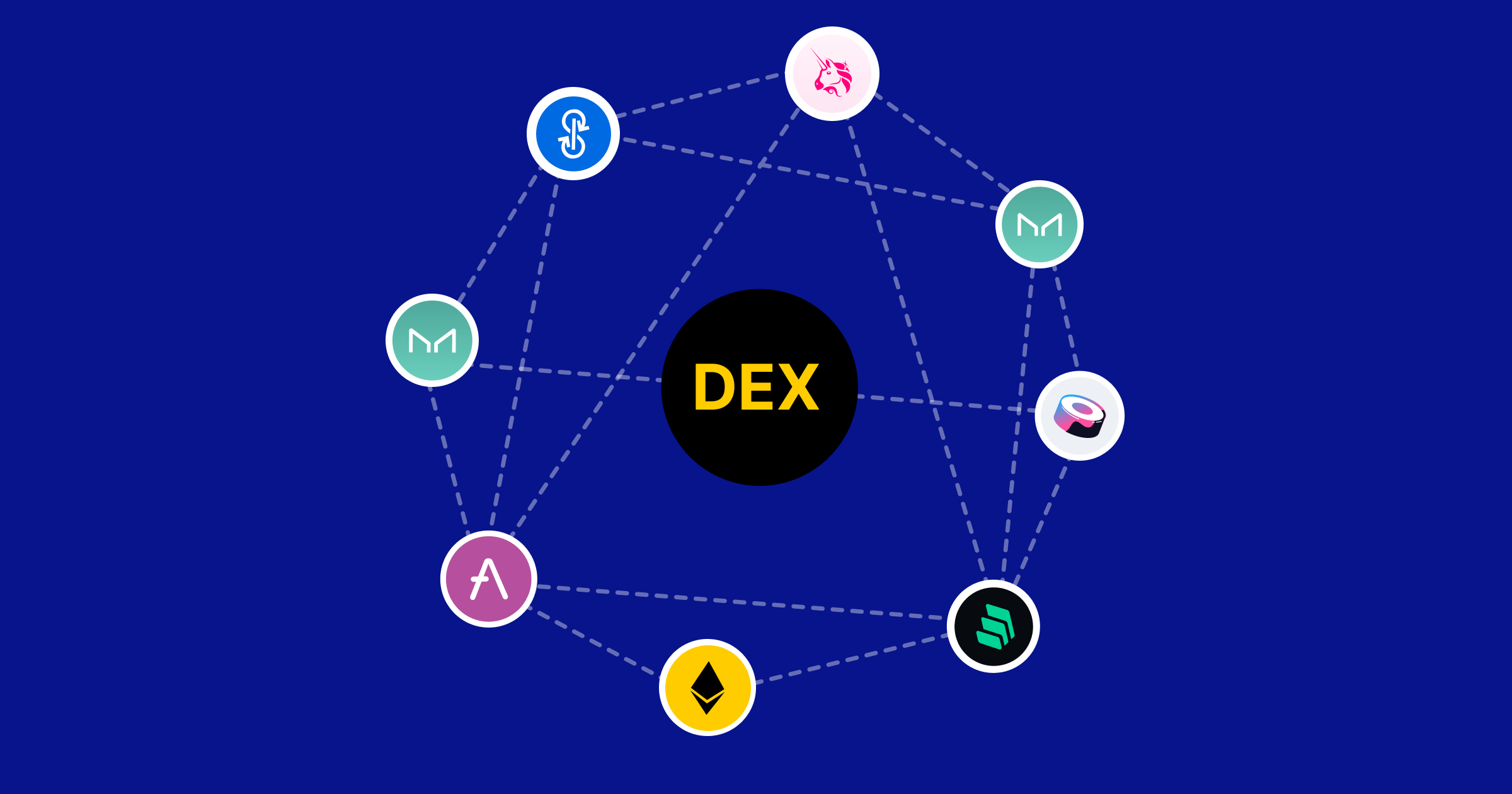
A decentralized exchange (DEX) facilitates direct peer-to-peer cryptocurrency trading without the need for a central intermediary. These platforms are built on blockchain protocols and powered by smart contracts, allowing users to maintain full control over their funds throughout the trading process.
DEXs embody the core principles of decentralization, offering enhanced privacy and reducing the risk of single points of failure associated with centralized entities.
How DEXs Operate
DEXs primarily function through two main mechanisms:
- Automated Market Makers (AMMs): Most modern DEXs, like Uniswap, utilize AMM models. Instead of an order book, AMMs rely on liquidity pools funded by users. Traders swap tokens against these pools, with prices determined by an algorithm based on the ratio of assets within the pool. Liquidity providers earn a share of trading fees.
- Order Book DEXs: Some DEXs, such as dYdX, still use an order book system, similar to CEXs. However, these order books are typically managed on-chain or off-chain with on-chain settlement, ensuring that users retain custody of their assets until a trade is executed.
Advantages of DEXs
- No KYC or identity verification required, offering greater privacy and accessibility.
- Users maintain full control of their private keys and funds, eliminating custodial risk.
- Reduced risk of platform hacks, as there are no centralized honey pots of user funds.
- Greater censorship resistance, as smart contracts operate autonomously.
- Access to a wider range of newly launched or niche tokens not yet listed on CEXs.
Challenges of DEXs
- Lower liquidity compared to centralized exchanges, potentially leading to higher slippage for large trades.
- Higher transaction fees (gas fees) during network congestion, especially on popular blockchains like Ethereum.
- More complex user experience for beginners, requiring familiarity with self-custody wallets and blockchain interactions.
- Limited fiat on-ramps, typically requiring users to acquire crypto on a CEX first.
- Vulnerability to smart contract bugs or exploits, although rare, can lead to significant losses.
Top DEX Platforms to Know in the Crypto Exchange Landscape
As decentralized finance (DeFi) continues its rapid expansion, several decentralized crypto exchanges (DEXs) have emerged as industry leaders. These platforms enable users to trade digital assets directly from their wallets, without any centralized control or intermediaries.
- UniswapUniswap: The most prominent Ethereum-based crypto exchange, Uniswap utilizes the Automated Market Maker (AMM) model. It allows instant swaps of ERC-20 tokens without an order book and is fully open-source, playing a central role in Ethereum’s DeFi ecosystem. Users can also earn rewards by providing liquidity to various trading pools.
- PancakeSwapPancakeSwap: Built on the BNB Smart Chain, PancakeSwap offers significantly faster and cheaper transactions than Ethereum-based DEXs. It is the most popular AMM DEX in the Binance ecosystem, supporting token swaps, yield farming, and staking. Its native CAKE token is used for governance and rewards.
- SushiSwapSushiSwap: Originally a fork of Uniswap, SushiSwap has evolved into a multi-chain crypto exchange supporting networks like Ethereum, Polygon, Fantom, and Avalanche. It offers a broader suite of features beyond token swaps, including yield farming, staking, and lending through its BentoBox ecosystem, appealing to users seeking a diversified DeFi experience.
Hybrid Exchanges
Hybrid exchanges aim to combine the best features of both CEXs and DEXs. They seek to offer the speed, liquidity, and user-friendliness of centralized platforms while providing the security and self-custody benefits of decentralized ones.
Typically, hybrid exchanges process order matching off-chain for speed and efficiency, but settle trades on-chain to ensure user control over funds. This approach attempts to mitigate the custodial risks of CEXs and the liquidity/speed issues of pure DEXs.
How Hybrid Exchanges Work
Hybrid models often involve:
- Off-chain Order Books: Orders are managed on a centralized server for rapid matching, similar to a CEX.
- On-chain Settlement: Once orders are matched, the actual transfer of assets occurs directly between users’ wallets on the blockchain via smart contracts, ensuring non-custodial trading.
- Decentralized Custody: Users retain control of their private keys, and funds are only moved from their wallets when a trade is executed and confirmed on-chain.
Advantages of Hybrid Exchanges
- Enhanced security through non-custodial asset management.
- Higher transaction speeds and greater liquidity than many pure DEXs.
- Improved user experience compared to complex DEX interfaces.
- Reduced gas fees for order placement and cancellation, as these actions often occur off-chain.
Disadvantages of Hybrid Exchanges
- Can still have a degree of centralization in their off-chain components, potentially introducing some counterparty risk.
- Fewer options and platforms compared to established CEXs and DEXs.
- Complexity in design and implementation can lead to unique vulnerabilities if not properly audited.
Peer-to-Peer (P2P) Exchanges
Peer-to-peer (P2P) exchanges enable direct cryptocurrency trading between individual users without a traditional intermediary. These platforms connect buyers and sellers directly, allowing them to agree on terms, prices, and payment methods.
P2P platforms often utilize an escrow system to secure funds during a trade, releasing them only when both parties confirm the transaction’s completion. This model offers significant flexibility in payment options and can be particularly useful in regions with restrictive financial regulations.
How P2P Exchanges Function
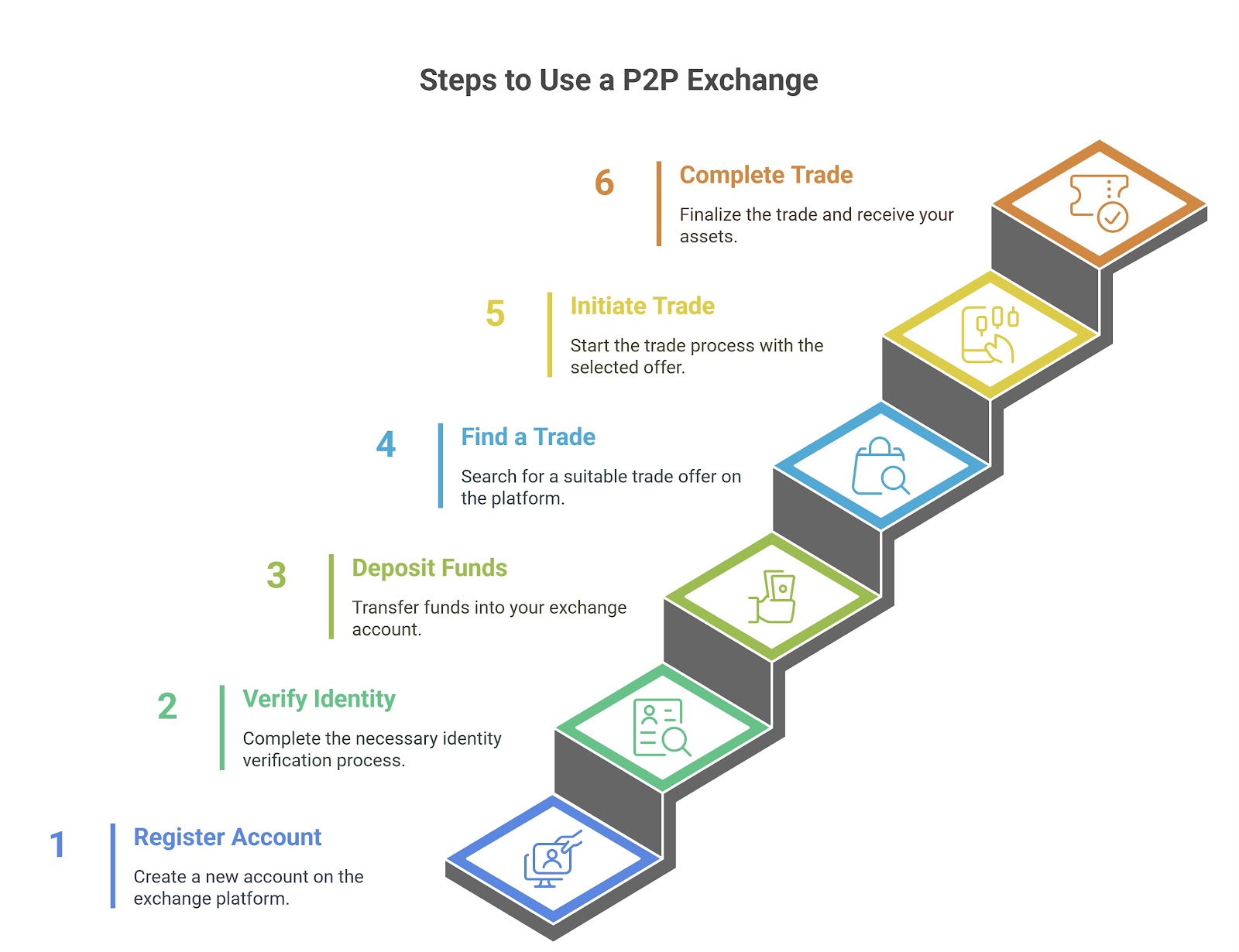
- Direct Connection: The platform acts as a marketplace to connect users, but the actual transaction occurs directly between them.
- Escrow System: The seller’s crypto is locked in an escrow service managed by the platform until the buyer confirms payment. This protects both parties.
- Diverse Payment Methods: P2P exchanges support a wide array of payment options, including bank transfers, mobile payments, gift cards, and even in-person cash exchanges, depending on the agreed terms.
- Dispute Resolution: P2P platforms typically offer a dispute resolution mechanism to mediate conflicts between traders.
Advantages of P2P Exchanges
- Greater privacy, as KYC requirements can be less stringent or optional depending on the platform and trade volume.
- Global accessibility, allowing users in various regions to trade even when traditional exchanges are restricted.
- Diverse payment options, offering flexibility beyond standard banking methods.
- Potentially lower fees compared to CEXs, as the platform’s role is primarily matching and escrow.
- User-defined pricing, allowing for negotiation between buyers and sellers.
Disadvantages of P2P Exchanges
- Slower transaction times due to manual confirmation of payments.
- Increased counterparty risk, as users interact directly with other individuals.
- Lower liquidity for specific trading pairs compared to CEXs.
- Potential for scams if users do not adhere to platform guidelines or exercise caution.
- Reliance on the platform’s escrow and dispute resolution system for security.
Understanding Crypto Exchange Types: CEX, DEX, Hybrid, and P2P Platforms
Selecting the optimal crypto exchange depends heavily on your individual priorities, experience level, and trading goals. Each type of platform offers a distinct set of trade-offs:
Key Factors to Consider
- Security: Evaluate the platform’s security measures, including cold storage, insurance funds, and user control over private keys. DEXs and P2P offer more self-custody, while CEXs provide institutional-grade security but with custodial risk.
- Liquidity: High liquidity ensures faster trade execution and better prices. CEXs generally offer the highest liquidity, followed by some large DEXs, with P2P often having the lowest.
- Fees: Compare trading fees, withdrawal fees, and network (gas) fees. These can vary significantly between platforms and blockchain networks.
- Ease of Use: Beginners often prefer the intuitive interfaces and customer support of CEXs. DEXs and P2P platforms require more technical understanding.
- KYC/Privacy: If privacy is a priority, DEXs and some P2P platforms offer trading without extensive identity verification. CEXs always require KYC.
- Asset Availability: CEXs typically list a broad range of established cryptocurrencies. DEXs can offer access to newer, more niche tokens.
- Payment Methods: Consider how you want to fund your account. CEXs offer diverse fiat on-ramps, while P2P platforms excel in flexible local payment options.
Comparison of Crypto Exchange Types
| Feature | Centralized Exchange (CEX) | Decentralized Exchange (DEX) | Hybrid Exchange | Peer-to-Peer (P2P) |
|---|---|---|---|---|
| Custody | Custodial (exchange holds keys) | Non-custodial (user holds keys) | Non-custodial (user holds keys) | Non-custodial (user holds keys) |
| KYC Required | Yes, typically strict | No, generally | Often minimal or none | Varies, often less strict |
| Liquidity | Very High | Moderate to High (for major DEXs) | High | Low to Moderate |
| Speed | Very Fast | Moderate (depends on network) | Fast | Slow (manual confirmation) |
| Fiat On/Off-Ramps | Yes, extensive | Rarely directly | Limited | Yes, diverse local options |
| Ease of Use | Beginner-friendly | More complex | Moderate | Moderate |
| Security Risk | Platform hacks, regulatory | Smart contract bugs | Hybrid vulnerabilities | Counterparty fraud |
Frequently Asked Questions about Crypto Exchanges
1. Is DEX trade decentralized? Yes, DEX trades are decentralized as they operate without intermediaries, allowing users to trade directly via smart contracts.
2. Which is the best DEX exchange? Popular DEXs include Uniswap, SushiSwap, and PancakeSwap. The best one depends on your preferred blockchain and specific trading needs.
3. Is Binance a DEX or CEX? Binance is primarily a centralized exchange (CEX), although it also operates Binance DEX as a separate, decentralized platform.
4. Is Coinbase a DEX or CEX? Coinbase is a centralized exchange (CEX), providing a user-friendly platform with extensive fiat support and compliance features.
5. Are DEXs safer than centralized exchanges? DEXs offer more user control and reduce custodial risk, but users must manage their own wallets and be aware of potential smart contract vulnerabilities. CEXs have institutional security but carry custodial risk.
6. Do DEXs require KYC? Most DEXs do not require KYC since users trade directly via self-custody wallets. However, this may change depending on evolving regulations.
7. Can I buy crypto with fiat on a DEX? Generally, no. DEXs do not natively support fiat currencies. You’ll typically need to purchase crypto on a CEX or use a fiat on-ramp service first, then transfer it to your wallet for DEX trading.
8. What tokens can I trade on a DEX? DEXs support a wide range of tokens, often including newly launched or niche tokens that may not yet be available on centralized exchanges.
9. Can I earn passive income using a DEX? Yes, by providing liquidity to pools on an Automated Market Maker (AMM) DEX, users can earn a share of trading fees and sometimes receive additional rewards in the form of governance tokens.
10. What blockchain networks support DEXs? Popular networks with robust DEX ecosystems include Ethereum, BNB Chain, Arbitrum, Polygon, Solana, and Avalanche. Each network hosts its own set of supported platforms and tokens.


